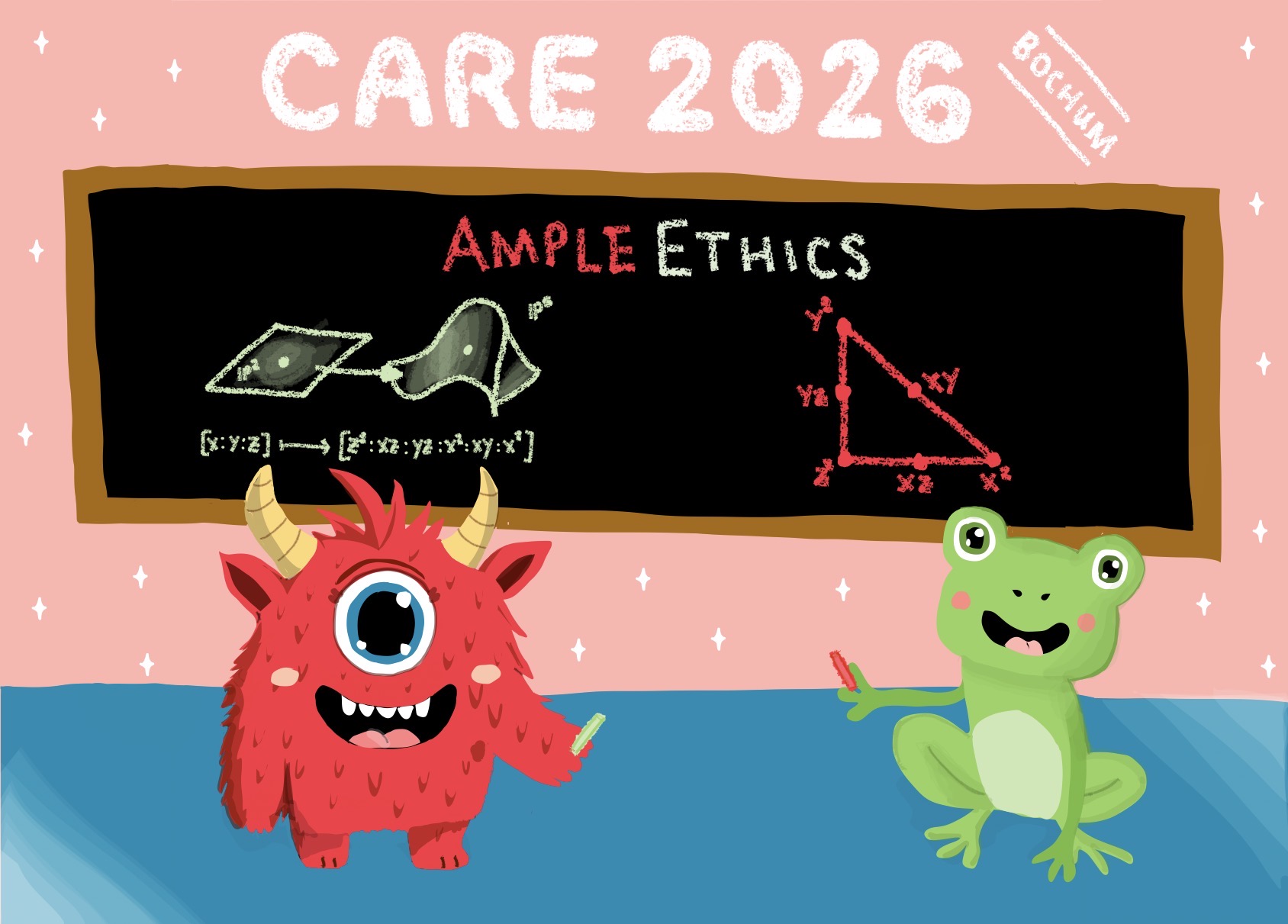
We are holding a 3 day workshop in Bochum, in September 2026!
Parallel to the research aspect, in organizing the CARE conference, it was of utmost importance for us to create an environment in which people could talk about and discuss ethical issues within our research community. In order to achieve this we planned some ethical activities: each day ended with a one hour ethics talk, given by experts, which was followed by a moment of collective discussion. We hope that this, together with the friendly environment we managed to create, helped participants to imagine positive changes in their respective institutions. The list of ethic topics that was discussed is not exhaustive and we hope we will be able to treat many more in future.
Many more ethical considerations were integrated into various aspects of CARE's organization. All meals and coffee breaks were vegetarian with vegan options. We were and will always be committed to gender equality and strive for equal representation in participant and speaker selection. We did not fund people travelling by plane but offered more financial support for those taking a long train trip, for instance paying for an extra night stay in order to break up the trip. We believe that avoiding air travel is a realistic and accessible choice for those that were interested in attending the conference, because of the local nature of the event and the fact that Lyon is easily accessible by train from many parts of Europe.
Alain Marois, Florence Codet, Filippo Nuccio
In this presentation, we will first deal with Open Science and its main issues, with a special focus on academic publications and different publishing models. In a second step, we will address the issue of ethics through practical examples of journals and publishing platforms.
Nina Gasking
What's the deal with outreach? Should you even bother? And if so, where do you begin? These might not be questions you've lost sleep over, but I'll give you the answers anyway! This talk will be all about mathematical outreach—what it looks like, why it's worth your time, and how it can transform the way people think about maths. I'll share my own take on it, including the hands-on activities I've tried and the moments where I realised that not every maths concept needs to be shared (and honestly, that's okay!). Be ready to join in for a small hands-on example (don't worry, nothing too intense). Together, we'll see how outreach can make maths more approachable, more fun, and maybe even more human.
Olga Paris-Romaskevitch
Based on a selection of works in social psychology, sociology, neuroscience, educational and cultural studies, I will show why women are pushed away from mathematics, and what we should do about mathematics (and not about women) to stop it from happening.
Laurent Jeanneau
In this presentation, we will first deal with Open Science and its main issues, with a special focus on academic publications and different publishing models. In a second step, we will address the issue of ethics through practical examples of journals and publishing platforms.
At the end of the conference, we asked participants to fill an anonymus feedback form, in which they could share their thoughts on the outcome of the conference. There were several questions regarding the ethical aspects of the conference as well. Here we report some of the numbers and details that came out of these feedbacks!
The following percentages are computed on the total number of participants who filled the feedback form (50%).
We are holding a 3 day workshop in Bochum, in September 2026!
We have an ongoing online seminar on ethics!
Please contact us at the email address below for any suggestion, question or feedback! We are happy to hear from you!