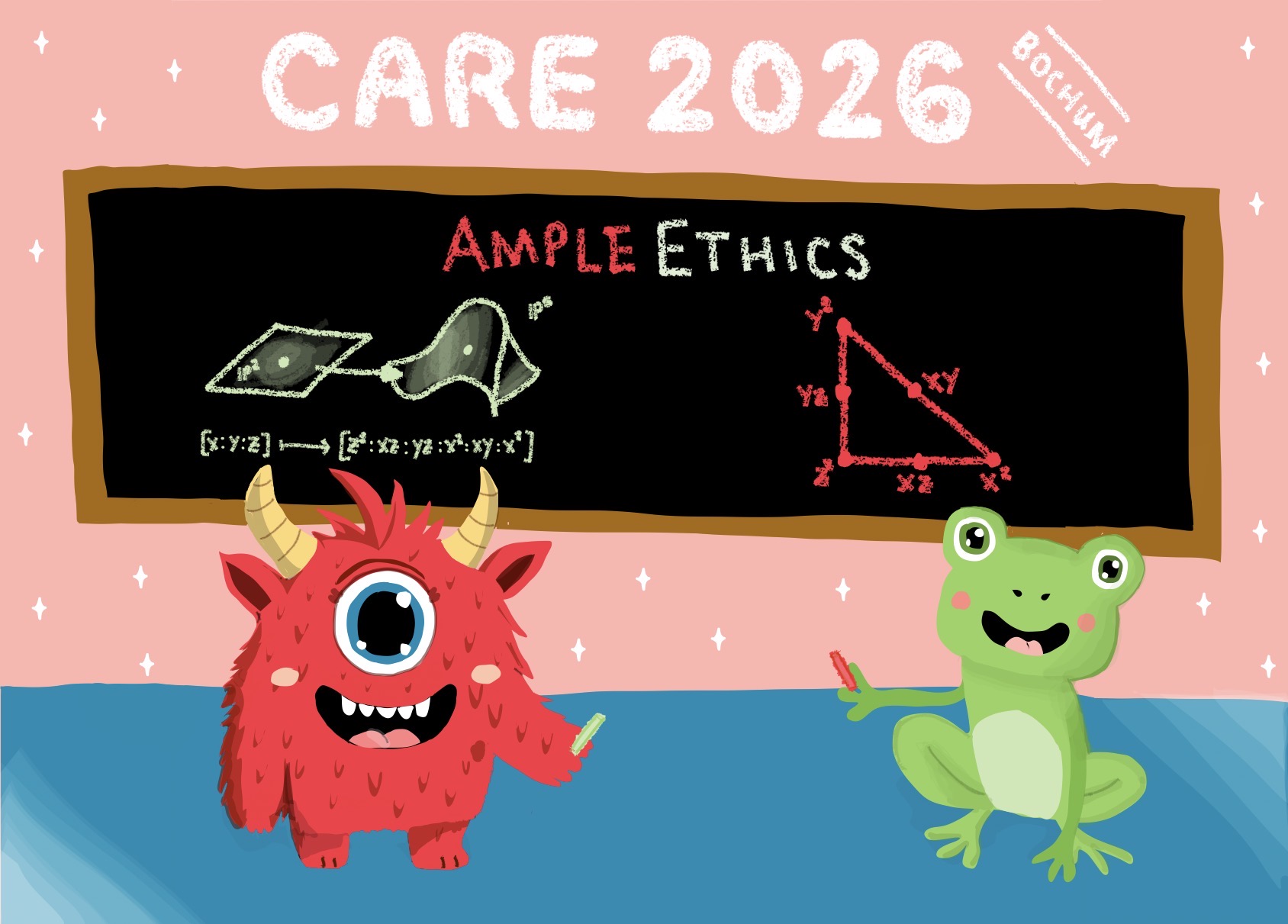
We are holding a 3 day workshop in Bochum, in September 2026!
The research program of CARE Lyon was designed with a focus on fostering collaborations between researchers from different but close areas of mathematics: algebra, representation theory and algebraic geometry. In order to achieve this we organized two morning mini-courses which treated topics that use many different tools and touch several areas of mathematics. The courses were designed to be as accessible as possible without sacrificing mathematical depth, so that everyone participating could learn something from following them. These mini-courses also highlighted accessible open problems, offering participants the opportunity to engage with them in future research. The afternoon was dedicated to research talks. We devoted this time to early career researchers such as PhDs and post-docs and in particular to people who are seeking for collaboration with other mathematicians.
In short, the CARE Lyon 2025 conference followed a three part format:
Surface combinatorics have been instrumental in describing algebraic structures such as cluster algebras, cluster categories, gentle algebras, etc. In this course, I will show how triangulations and tilings of surfaces give rise to cluster categories and to module categories for gentle algebras.
In the case of a disk, triangulations and certain diagrams yield a combinatorial approach to cluster structures on the (coordinate ring of the) Grassmannians. These diagrams provide cluster-tilting objects corresponding to Pluecker coordinates. In general, the categories are of infinite type. The objects corresponding to Pluecker coordinates may be viewed as building blocks for arbitrary objects. We explain constructions of higher rank objects and will discuss a link to root systems associated to the Grassmannian cluster structure.
Cohomological Hall algebras (CoHAs) are certain associative algebras, for which the underlying vector spaces are given by the equivariant cohomology of moduli spaces of objects in an Abelian category, and for which the product is induced via the structure of extensions in the same category. The CoHAs I will focus on in these talks are built in this way from the category of representations of preprojective algebras. We will cover general structure theorems regarding CoHAs, including a Poincaré-Birkhoff-Witt theorem that enables us to encode the graded dimensions of these CoHAs using the coefficients of Kac polynomials. The Kac polynomials are defined by counting representations of quivers (up to isomorphism) over finite fields, and so are quite classical. Secondly, we will see how parts of these CoHAs arise as universal enveloping algebras of Kac-Moody Lie algebras, and their generalisation due to Borcherds. Finally, we will study the representation theory of these CoHAs, which is approached via Nakajima's quiver varieties and geometric representation theory, and use this as a bridge to compare these CoHAs with generalised Yangians (a class of quantum groups) introduced by Maulik and Okounkov.
Frédéric Chapoton
We will discuss two families of polytopes with similar flavour. The first ones, very classical, are named associahedra but the second ones, named halohedra, are more recent. One can describe in simple combinatorial terms their graphs of vertices and edges. The construction of polytopes that realize this combinatorics is a long story, with many players and many solutions. The parallel between these two families is not yet complete: there remains to invent a natural orientation of the edges of halohedra, whose existence is suggested by a recent new viewpoint on "Coxeter-Catalan combinatorics".
Valerio Melani
Let G be a complex affine algebraic group. If C is a smooth algebraic curve and x is a point in C, the affine Grassmannian is an algebro-geometric object that parametrizes G-bundles on C together with a trivialization outside x. Alternatively, one can define the affine Grassmannian as the quotient G((t))/G[[t]]. In this talk we present possible analogs for the affine Grassmannian, in the setting where the curve is replaced by a smooth projective surface, and the trivialization data are specified with respect to flags of closed subschemes. We also obtain parallel descriptions in terms of quotients of the double loop group G((t))((s)). Based on joint works with B. Hennion, A. Maffei and G. Vezzosi.
Bárbara Muniz
Kostka–Foulkes polynomials K_{\lambda,\mu}(q) are important combinatorial objects which have many incarnations in representation theory. We will characterize them in two different ways: as affine Kazhdan-Lusztig polynomials and as q-analogues of Kotska numbers, which count the weight multiplicities in irreducible representations. Then, we will discuss one of the most long-standing open problems in algebraic combinatorics: finding a closed and positive formula for these polynomials, together with a geometric interpretation. This includes a brief overview of a recently developed approach which has already been used to solve the problem for type A and C_2.
Tommaso Scognamiglio
The (complex) character table of the finite group GL_n(F_q) has been known since the 50s, thanks to the work of Green. Later, Deligne and Lusztig gave a geometric description of it, thanks to Deligne-Lusztig induction and character sheaves. However, not much is known concerning the computation of multiplicities, i.e. understanding the decomposition of tensor products of irreducible representations. This decomposition are well understood just in the so-called generic case, thanks to the work of Hausel, Letellier and R-Villegas, who also related them to character and quiver varieties. It is a natural question to ask how to generalize these results to the computation of all multiplicities. In this talk, I would like to present a first result in this direction and suggest possible ways to tackle the problem. In particular, I will quickly explain how to compute the decomposition of tensor products of the so-called semisimple split representations. This results relates multiplicities to the counting of representations of certain quivers over F_q. This method does not extend in general. Computations suggest that we should pursue a more geometric approach and study rather certain related quiver moduli spaces. I would like in particular to explain how the general computation could be related to the understanding of COHAs and BPS algebras for certain quivers.
Judith Marquardt
Let A be a gentle algebra. For every collection of string and band diagrammes, we consider the constructible subset of the variety of representations containing all modules with this underlying diagramme. For instance, to a band we associate the set of corresponding band modules with all choices of parameters. We study degenerations of such sets and show that some of them are induced by kissing of string and band diagrammes. This work combines representation theory of finite dimensional algebras with algebraic combinatorics and algebraic geometry.
Francesca Paganelli
Shifted quantum affine algebras are quantum groups parameterized by a coweight of the underlying Lie algebra. Hernandez introduced in 2022 a category O of representations of these algebras and in 2024 Geiss-Hernandez-Leclerc proved that the Grothendieck ring of this category O has a cluster algebra structure. In this talk I will present a new quantization for this cluster algebra that allows us to define the quantum Grothendieck ring of such category O (in the spirit of Nakajima and Varagnolo-Vasserot). If time permits, I will explain how to deduce from this construction the so-called quantum QQ-systems and a quantum cluster algebra structure on the q-oscillator algebra.
Luigi Caputi
In the talk, we will introduce the notion of reachability categories. These categories are obtained from path categories of quivers by taking quotients under the "reachability" relation. We will compare reachability categories to path categories, from both a topological and a categorical viewpoint. Then, we will focus on the category algebras of reachability categories, also known as commuting algebras. As application, we will prove that commuting algebras are Morita equivalent to incidence algebras of posetal reflections of reachability categories, a result previously obtained by E. L. Green and S. Schroll. If time allows it, we shall see further connections to magnitude homology, Hochschild cohomology, and persistent homology of graphs. This is joint work with H. Riihimäki.
Inder Kaur
Hecke modifications of vector bundles on curves have been studied for decades and have connections with automorphic forms, Hall algebras and parabolic bundles. In rank 2 there exists a correspondence between Hecke algebras and quasi-parabolic bundles. In this talk, I will discuss this correspondence, and its generalisation for higher rank, applications to other topics and some open questions. A part of this is joint work with Roberto Alvarenga and Leonardo Moco.
Simone Castellan
Given a non-commutative algebra Q and its semiclassical limit A, an intriguing question has always been “Do the properties of Q always reflect the (Poisson) properties of A?”. Of particular interest is the behaviour of automorphisms. The most famous example is the Belov Kanel-Kontsevich Conjecture, which predicts that the group of automorphisms of the nth-Weyl algebra A_n is isomorphic to the group of Poisson automorphisms of the polynomial algebra C[x_1,…,x_{2n}]. In this talk, I will present my work on a problem similar to the BKK Conjecture. Take a symplectic quotient singularity; the parameter spaces of filtered deformations and the parameter space of filtered quantizations coincide. Do the Poisson isomorphisms between the deformations coincide with the automorphisms between the quantizations? I have a positive answer in the special case of Kleinian singularities of type A and D, but the general problem remains open.
Sami Al-Asaad
Given a projective variety X, one can construct a geometric object parametrizing the endomorphisms of X, known as the endomorphism scheme. The set of its connected components naturally carries the structure of a monoid. In this talk, I will present some finiteness results concerning such monoids of connected components (for example, the finite subgroups of each maximal subgroup have uniformly bounded orders). I will also discuss basic connections with the geometry of X, and conclude with an open question about whether these monoids can be bounded "globally".
Thibault Julliard
Affine W-algebras form a family of vertex algebras generalising affine and Virasoro Lie algebras. They are in 1-to-1 correspondence with some affine Poisson varieties, the Slodowy slices. In this talk, I will present how one can use Poisson geometry to prove reduction by stages for affine W-algebras. By definition, we say that reduction by stages holds whenever some W-algebra can be obtained as the non-commutative Hamiltonian reduction of another W-algebra. This work is joint with Naoki Genra.
Raphaël Paegelow
The Gieseker space is a generalization of the Hilbert point scheme. We will present combinatorial correspondences between the irreducible components of the locus of fixed points of the Gieseker space and the block theory of the Ariki-Koike algebra. First, we will describe the locus of fixed points in terms of Nakajima quiver varieties over the McKay quiver of type A. Then, we will present how to recover the combinatorics of cores of charged multipartitions, as defined by Fayers and developed by Jacon and Lecouvey, on the Gieseker side. In addition, we will present a new way to compute the multicharge associated with the core of a charged multipartition and how the notion of core blocks, discovered by Fayers, can be interpreted geometrically. Finally, if time permits, we will present the work in progress concerning the generalization to cyclotomic KLR algebras of other types and the potential deepening of these connections.
Dani Kaufman
One of the best known family of cluster algebras come from the Grassmannians Gr(k,n). These cluster algebras are known to be related through categorification to surface singularities of the form x^k+y^{n-k}+z^2=0. They are finite type only when (k-2)(n-k-2) is less than 4 and such cases are exactly when the corresponding singularity is ADE type, and moreover the cluster type matches the singularity type. The combinatorics of the corresponding ADE root system essentially completely controls the properties of the cluster algebra and the singularity. Following the program of Arnold, surface singularities beyond ADE type are classified into various families based on “modality” and other invariants. Moreover following work of Ebeling and others, Dynkin diagrams for some of these singularities have been constructed. The question I wish to propose is essentially “what is the “type” of the Grassmannian cluster algebras beyond the finite cases?”. I propose that the answer should be found by further studying the connection between Grassmannian cluster algebras and surface singularities. The first step towards understanding this should be constructing special seeds of the cluster algebra which correspond to these Dynkin diagrams. With this we can hope to have a much better understanding of the combinatorics and properties of the infinite type Grassmannian cluster algebras.
Konstantin Jakob
About 10 years ago, Schiffmann proved that the number of absolutely indecomposable vector bundles on a curve over a finite field (with degree coprime to the rank) is equal to the number of stable Higgs bundles of the same rank and degree (up to a power of q). Dobrovolska, Ginzburg and Travkin gave another proof of this result in a slightly more general formulation, but neither proof generalizes in an obvious way to G-bundles for other reductive groups G. In joint work with Zhiwei Yun, we generalize the above results to G-bundles. Namely, we express the number of absolutely indecomposable G-bundles on a curve X over a finite field in terms of the cohomology of the moduli stack of stable parabolic G-Higgs bundles on X. For G=GL(n), Schiffmann also proves that this number is given by an explicit polynomial in the Weil numbers of X, thus giving a closed formula for the Poincaré polynomial of the moduli space of stable Higgs bundles. Such explicit calculation remains an open question for general G.
Joseph Winspeare
The geometric model for the derived category of a gentle algebra (Opper-Plamondon-Schroll 2018) uses graded curves on a surface to describe indecomposable objects and morphisms. However, not all curves are gradable. A natural question is to ask if there exists a category with a geometric model using all curves on this surface. In this talk I will first present the geometric model for the derived category of gentle algebras of finite global dimension and how to construct its 1-periodic derived category. This category can be seen as the stable category of maximal Cohen-Macaulay modules over an extension of A and indecomposable objects are parametrized by all curves on the surface.
Fang Yang
For a smooth curve C, the Schur algebras are defined by the Borel-Moore homology of Steinberg-like stacks built from coherent sheaves on C. In the case C=P^1, we construct a PBW basis for this algebra. Using the derived equivalence between the category of coherent sheaves on P^1 and the category mod - C(Q) of quiver representations of the Kronecker quiver Q, we show that its Schur algebra is an inverse limit of certain quotients of the quiver Schur algebras for Q. This is a joint work with Olivier Schiffmann.
Wannes Malfait
For many quantum groups a quantum cluster algebra structure is known, giving a combinatorial framework to study these algebras. On the other hand, such quantum groups can sometimes also be defined in the analytical setting, e.g. as locally compact quantum groups. We present some ongoing work to combine the cluster structure with the analytical structure, leading to applications in the theory of positive representations.
Elena Pascucci
The study of trace identities, which is closely related to the invariant theory of n x n matrices, plays a significant role in contemporary mathematics and has crucially contributed to the development of PI-theory. The foundational contributions to this area were made by Procesi and Razmyslov, who independently proved that all trace identities of the full matrix algebra M_n(F) of order n are consequence of a single polynomial derived from the Cayley-Hamilton theorem. Within PI-theory, a notable class of algebras is formed by upper triangular matrix algebras. In this context, Berele identified a set of generators for their trace identities. However, upper triangular matrix algebras admit a wide range of trace functions. In this talk, we extend Berele’s results, by determining generators of trace identities of 2x2 upper triangular matrices for all possible traces and provide general results regarding n × n upper triangular matrices. In particular, a complete generalization of Berele’s results for n > 2 is still not known.
At the end of the conference, we asked participants to fill an anonymus feedback form, in which they could share their thoughts on the outcome of the conference. Here are several questions regarding the scientific aspects of the conference as well. Here we report some of the numbers and details that came out of these feedbacks!
The following percentages are computed on the total number of participants who filled the feedback form (50%).
We are holding a 3 day workshop in Bochum, in September 2026!

We have an ongoing online seminar on ethics!
Please contact us at the email address below for any suggestion, question or feedback! We are happy to hear from you!